Zone 2 has become the most talked-about number in amateur cycling. Ride easy, stay in the zone, build your base. It is good advice, and it works.
If the term is new to you: training zones divide effort into numbered bands, from very easy up to all-out. Zone 2 sits near the easy end — light enough to hold a conversation, and light enough to keep going for hours. The advice is that most of your riding should sit there.
But most of us are following it using a number that quietly stopped being true several weeks ago.
Where your zones actually come from
Your zones are not a property of your body. They are a property of a test you did once.
You did an FTP test in March, or you let an app estimate your maximum heart rate from your age. Everything after that is arithmetic: percentages applied to that one figure. Zone 2 is a slice of a number you established on a single morning, under whatever conditions happened to exist that day.
There is nothing wrong with the math. The problem is that the input has a shelf life, and nothing in the system tells you when it has expired.
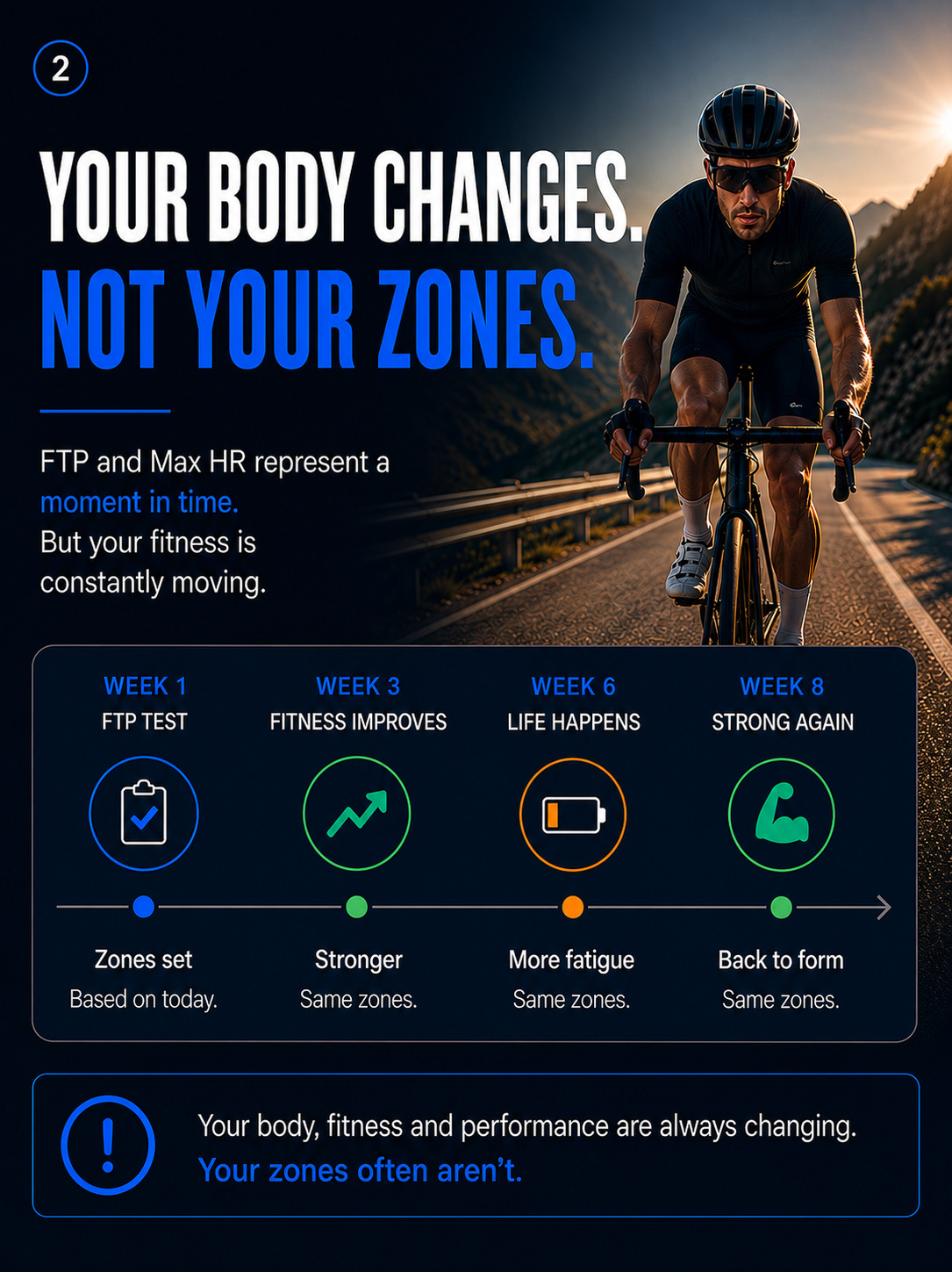
Your body changes. Your zones don’t.
Think about what actually happens over eight weeks.
- Week 1 — you test, and your zones get set.
- Week 3 — training is going well and you are genuinely stronger.
- Week 6 — work gets busy, you sleep badly, you pick up a cold.
- Week 8 — you come good again.
Through every one of those weeks, the zones on your head unit are identical. Your fitness moved three times. The numbers describing it moved zero times.
So what is Zone 2 on a Tuesday in October?
If you have improved since your test, the watts you are holding are now slightly too easy — you are doing a genuine recovery ride and calling it endurance. If you are run down, that same wattage is quietly costing you a tempo effort — a genuinely hard, sustained one — and you are left wondering why an easy ride felt so hard.
The number was never lying. It just stopped describing you, and it has no way of telling you so.
For most recreational riders this is not a small window. Retesting is unpleasant, so it gets postponed. A number set in spring routinely runs the whole season.
A different question
RideIQ is not a training planner. It does not prescribe intervals, it does not build a plan, and it does not tell you what to do on Saturday. That is a deliberate choice, and the case for it is in Ride your ride. RideIQ writes it up.
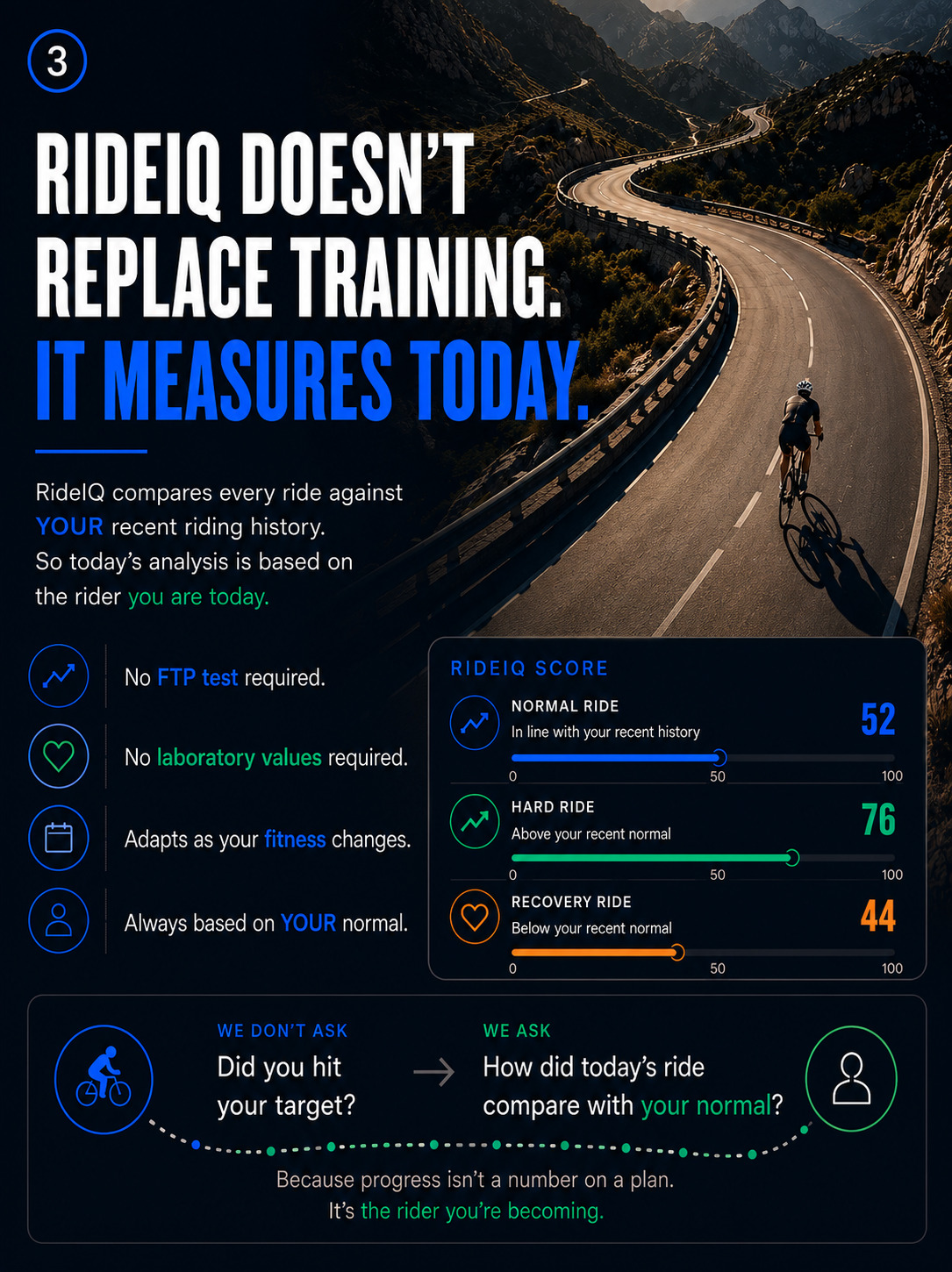
What it does is compare every ride against your own recent riding history. No FTP test, no lab values, no zones to configure. The reference updates itself every time you ride, so today’s ride is measured against the rider you are now — not the rider you were at your last test.
The question changes. Instead of did you hit your target, it asks how did today’s ride compare with your normal.
Both answer something the other cannot
This is not an argument that zones are useless. They do something a history-based score genuinely cannot: they prescribe. If a coach wants you doing three ten-minute efforts at a prescribed intensity, that instruction has to be anchored to a number.
A relative score cannot tell you what to do. It tells you how it went.
One estimates your potential. The other measures what actually happened, against your own normal.
If you are following a structured plan built on zones, keep it. But if you are not — and most of us are not — you do not need to build one just to find out whether you are getting fitter. We made a fuller case for that in Stop chasing estimates. Start measuring progress.
The rider you are today
Your potential was never defined by an estimate from a test in March.
Ride, and let the measurement keep up with you.

Measure today’s ride against the rider you are now.
Free for 30 days, no obligation. Subscribe whenever you like — the rides you have already brought in stay yours either way.
New to RideIQ? See everything the app does →