The first time I followed a structured plan properly, my bike computer beeped at me for an hour.
Too high. Too low. Back into the zone. There was a countdown in the corner of the screen and a target I was supposed to sit on, and every time the road tilted, or a gust caught me, or I stood up out of the saddle, the alarm went off to tell me I had done it wrong.
I finished having hit the numbers. I had not enjoyed a minute of it.
A plan turns a ride into a task
That is the part nobody warns you about. A plan does not just tell you what to do — it quietly changes what the ride is for. You are no longer out riding. You are completing something, and the road becomes the place where compliance happens.
So you do not chase the wheel that goes up the road, because it is not on the plan. You do not take the long way home when the light is good, because it would push the numbers. You ride past the climb you have been meaning to try. The ride goes exactly as prescribed, and none of the reasons you started cycling get a look in.
Life does not follow a training calendar
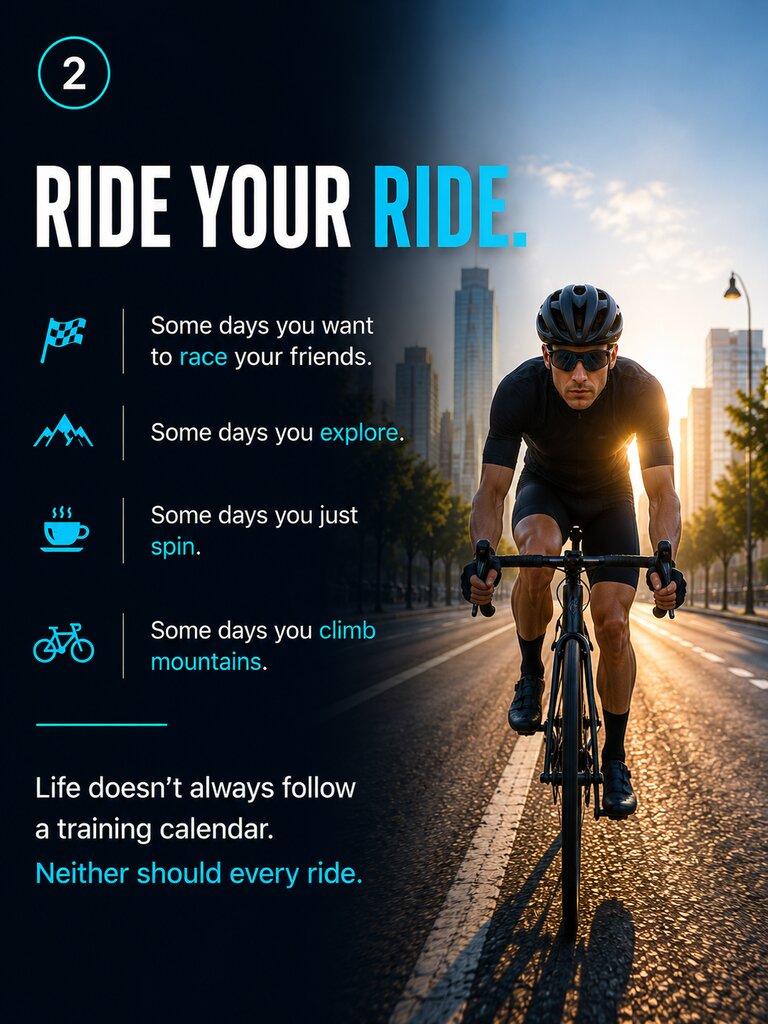
Some days you want to race your friends. Some days you want to explore a road you have never ridden. Some days you have ninety minutes and tired legs and you just want to spin. Some days a mountain looks like a good idea.
A calendar cannot know which of those days today is. It was written weeks ago by someone who did not know you would sleep badly, or that the weather would turn, or that your friend would text at seven in the morning asking if you fancy the long loop.
What riding actually looks like
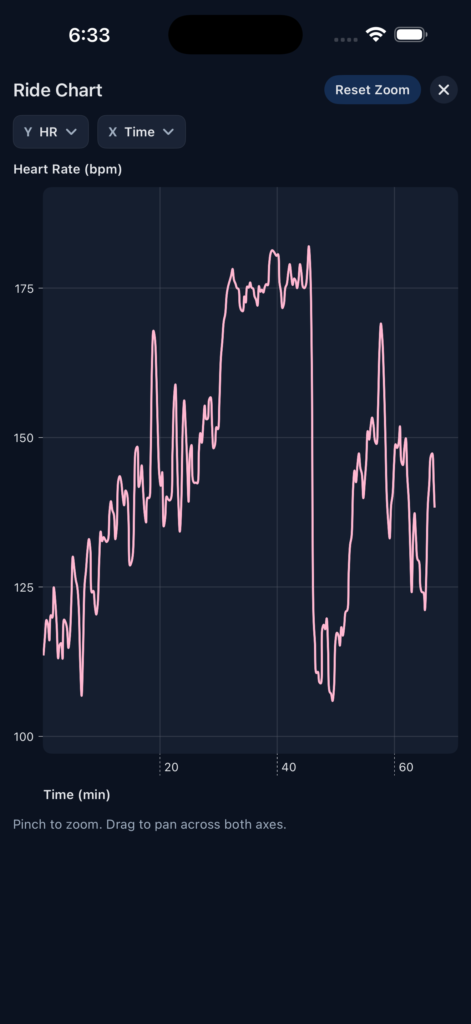
Here is an hour of real riding, measured two ways. On the left, the power. On the right, the heart rate of the same rider, on the same ride, over the same sixty-five minutes. It was a flat criterium circuit and it was not a race — but there were some very quick riders out there, and I spent most of the hour trying to hold their wheel.
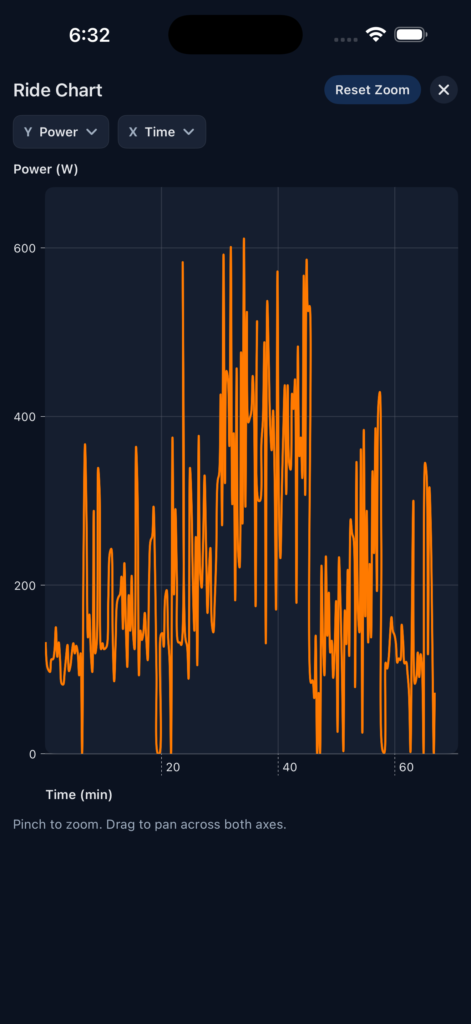
The power chart never settles. It swings between nothing and six hundred watts, over and over, for the whole ride.
There are no hills in there to explain the spikes — sixty-seven metres of climbing across thirty-three kilometres, which is as close to flat as a road gets. Every one of those swings is a corner or a wheel: brake, turn, accelerate out to close the gap, freewheel for a moment, do it again.
And this is the part a target cannot survive. I was not choosing those efforts. The riders in front were choosing them, and my only options were to respond or to be dropped. Any alarm telling me I was above my zone would have been correct, continuously, for an hour — and obeying it would have meant riding home on my own.
The heart rate chart is almost the opposite. It climbs steadily through the first half hour, sits high for a while, drops away sharply, and builds again. Smooth curves, nothing jagged.
Two pictures of one ride. Both true.
An alarm cannot work on that shape
Draw a target line across that power chart and count how many times it gets crossed. Hundreds. Every one of those crossings would be a beep, and not one of them would be a mistake — they are corners, and accelerations, and the wheel in front, and the ordinary business of moving a bicycle along a road.
An alarm policing that number is not correcting an error. It is reacting to cycling.
The second chart shows why this is worse than it first appears. Your body did not experience that hour as spikes. Heart rate takes twenty or thirty seconds to answer a change in effort, so what the rider actually felt was the smooth version. The number being policed moves far faster than the person being policed can respond — which is why the beeping feels unfair even when the device is working exactly as designed.
Real events do not happen at a steady number either
And that was a training ride on flat ground. A race is the same shape with more of it: answering attacks, closing gaps, recovering just enough to do it again. A hilly Sunday is thirty efforts of different lengths, none of which you chose in advance.
Nor does any of this require an official event. Most cities have a morning ride that assembles itself — no entry fee, no numbers, nobody officiating — and everybody in it entirely serious about the next sprint. Those rides are frequently harder than the events people pay to enter.
You cannot bring a plan to one. The pace is set by whoever is feeling good, the surges arrive without warning, and the only choice on offer is to go with them or let the group ride away. A zone target there is not hard to follow. It is irrelevant.
Riding at a fixed target trains you to hold a number. Riding with other people asks you to respond to one. Those are different skills, and only one of them can be practised on a road with other cyclists on it.
RideIQ is not on the ride at all
No beeping. No countdown. No wrong zone.
There is nothing to silence, because RideIQ is not there. It does not record your ride and it does not sit on your handlebars. Your head unit or your phone does the recording, exactly as it already did, and RideIQ reads the ride afterwards from whatever arrives in Strava.
So ride the way you feel. Push harder because the road looked good. Back off because you did not sleep. Attack a climb for no reason at all. Stop for coffee and ride home slowly. Nothing is watching, and nothing has an opinion until you are back.
And then it tells you what happened
This is the half that matters. When the ride is over and the data has come in, RideIQ measures what you actually did against the riding you have actually been doing.
How hard was it. Was it harder than your normal. Where are you improving. What deserves attention. How does today compare with the last three months of your own riding, rather than with a table of strangers.
None of those questions need to be answered while you are riding. All of them are more useful afterwards, when the whole shape of the ride exists and can be looked at properly.
And you do not have to go looking for any of it. RideIQ writes each ride up on its own — a plain language summary of what happened, waiting when you next open the app.
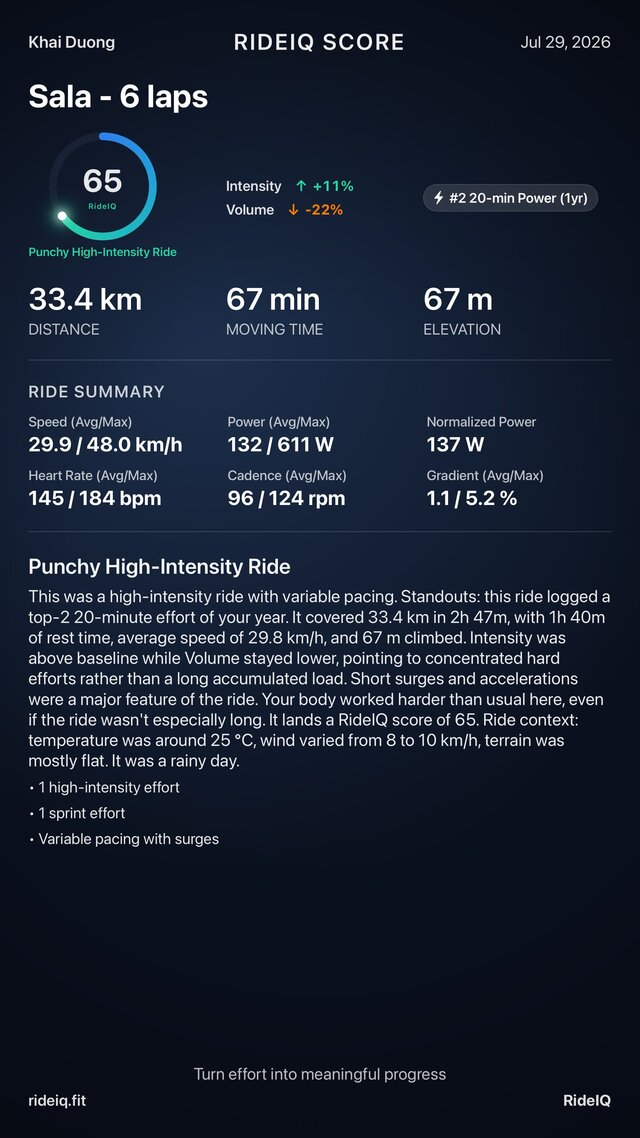
Here is what it made of that criterium ride. A score of 65. Intensity eleven per cent above my normal, volume twenty-two per cent below it. Average power 132 watts against a maximum of 611 — the whole argument of this article, expressed as two numbers. It also noticed that the ride contained my second-best twenty-minute effort of the year, which I did not know at the time and would never have worked out on my own.
The write-up calls it a punchy, high-intensity ride with variable pacing, and says short surges and accelerations were a major feature of it. That is the power chart, described back to me in a sentence.
And what you do with that is yours. RideIQ will tell you how much the ride took out of you, and how much rest it reckons that warrants — but a suggestion made after the fact is not a schedule. There is no session queued up for tomorrow, nothing to fall behind on, and nothing breaks if you ignore it. Whether the next ride is a rest day, a long one, or the climb you have been avoiding stays entirely your call.

What this does not replace
Worth being straight about the limits of the argument. If you have a date in the calendar and something specific to be ready for, structured training is the right tool and this is not a substitute for it. Plans exist because they work. Intervals prescribed at particular intensities build particular things, and no amount of riding by feel will replace a well-built block if you have a goal that demands one.
Plenty of riders do both — follow a plan through the winter, ride however they like through the summer, and want to understand all of it either way. RideIQ does not care which of those you are doing. It reads the ride you did.
The case against fixed zones is in Your Zone 2 isn’t always Zone 2, and the reasoning behind measuring every ride against your own history is in Stop chasing estimates. Start measuring progress.
But most of us are not on a plan. Most of us are riding because we like riding, with a quiet hope that we are getting better at it. You should not have to take on a training programme just to find out whether that is true.
Ride your ride
The best rides are rarely the ones that went to plan. They are the day the weather turned and you kept going, the climb you finally attacked, the sprint for a sign that meant nothing to anyone else.
Those rides are worth measuring too. They just should not need permission first.
Ride your ride. RideIQ writes it up.
Ride however you like. RideIQ will tell you how it went.
Free for 30 days, no obligation. Subscribe whenever you like — the rides you have already brought in stay yours either way.
New to RideIQ? See everything the app does →