You rode somewhere remarkable. Two hours, a river, a climb you had been putting off for months, light coming through the trees on the way back.
Your bike computer recorded every second of it and handed you back a table of averages and a thin grey line on a map.
A ride file is a recording, not just a data set
Here is something easy to forget about the file your head unit produces: it is not only a set of measurements. It is a second-by-second record of exactly where you were, how fast you were moving and how hard you were working, for the whole ride.
Everything needed to rebuild that ride is already sitting in it. Every corner you took. Every time you slowed for a junction. The pace you settled into once the road tilted up.
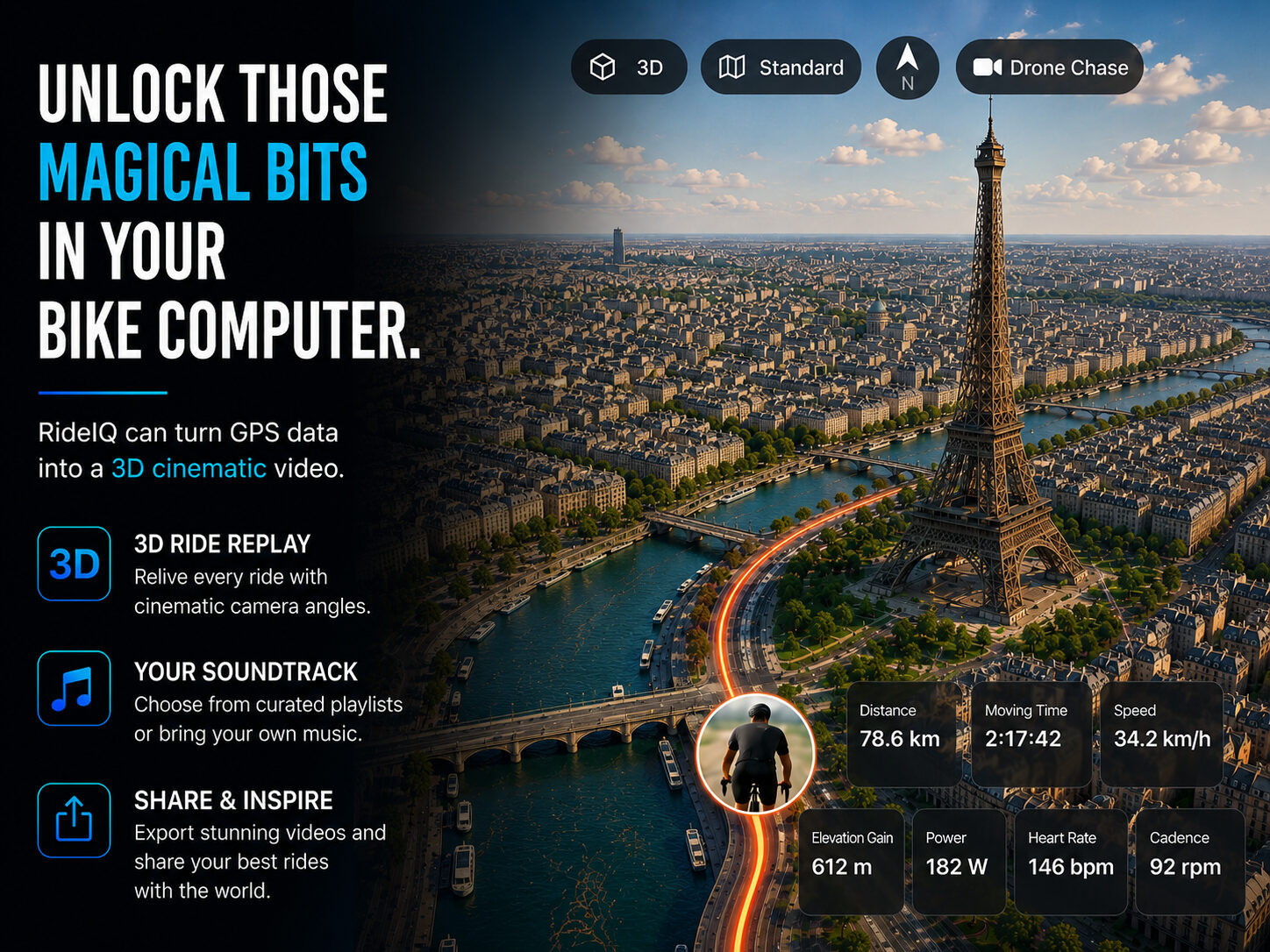
Most of RideIQ mines that file for what it can tell you about your fitness. Replay does the opposite — it uses the same data to give the ride back to you.
A replay you watch, not a video you receive
Plenty of tools will turn a GPS track into a video. You request one, you wait, a file arrives, you watch it once and you post it. Then it is done.
Replay is not that. It is something you open.
The flyover runs live, on the ride you just finished, whenever you want it — the evening you got home, or nine months later when somebody asks about that trip. You can scrub it, slow it to real time or run it at a hundred times speed. The exported video is a by-product of a replay you can actually sit and watch, rather than being the only thing on offer.
That distinction sounds small until you notice which rides you keep going back to.
Eleven camera angles
A single follow-cam gets dull in about twenty seconds.
Proper coverage of a bike race never comes from one camera. It comes from a helicopter, a motorbike, a fixed roadside position, and somebody in a truck deciding when to cut between them.
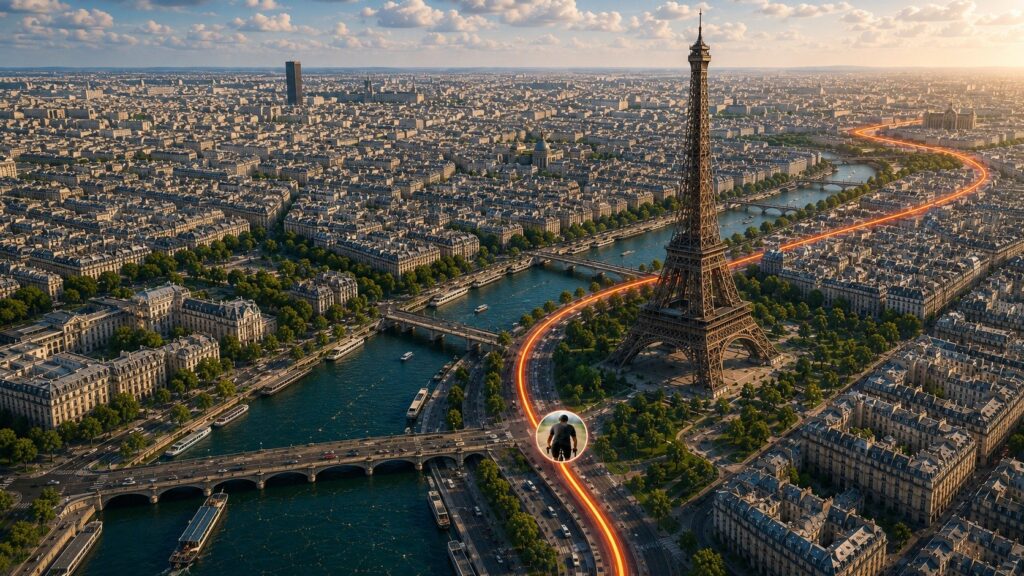
Replay is built the same way — eleven distinct angles, planned as shots rather than offered as settings. And somebody in the truck. We call it the RideIQ Director: the engine that picks the moments, chooses which camera covers each one, and decides where the cuts fall.
- Helicopter Wide — the high establishing shot, looking down on where you are and where you are heading.
- Rear Chase — low and grounded, sitting just off your back wheel.
- Drone Chase — the tightest follow there is, close to the ground and quick.
- Drone Side — a tight lateral drone, tracking alongside you.
- Side Left and Side Right — profile shots, where the landscape rips past behind you.
- Front Lead — the hero shot, camera out ahead and facing back at you.
- Fly Past — a sweeping oblique pass across your line of travel.
- Climb Reveal — angled up the road ahead, so you see what you are about to ride into.
- Urban Skyline — a steep, low angle where buildings and terrain tower up into frame.
- Long Reveal — the widest of the lot, pulling back until the shape of the entire route is visible.
The order is not random either. It is a weighted shuffle rather than a straight sequence — openings favour the establishing shots, finales favour the Long Reveal, and the camera pulls back at the end so you finally see the whole ride at once.
Which means no two exports look quite the same. The moments are the ride’s own — its real peaks and highlights, and those do not move. But the camera work is dealt fresh every time, so exporting the same ride twice gives you the same story shot differently: a climb covered from the drone once and from the helicopter the next time. Same race, a different director’s cut.
Real terrain, real buildings
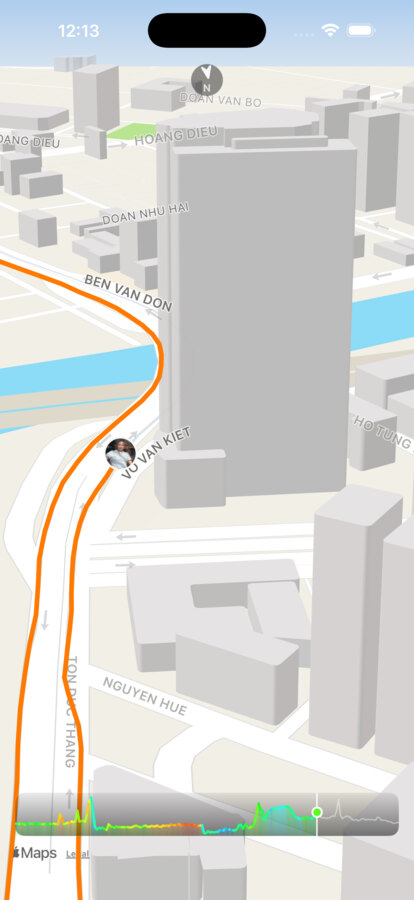
The map underneath is not a flat cartoon. It renders with genuine 3D elevation, so the hills you rode are hills. You watch the road rise ahead of you because it did rise ahead of you. There is a satellite option if you would rather see the actual ground you covered.
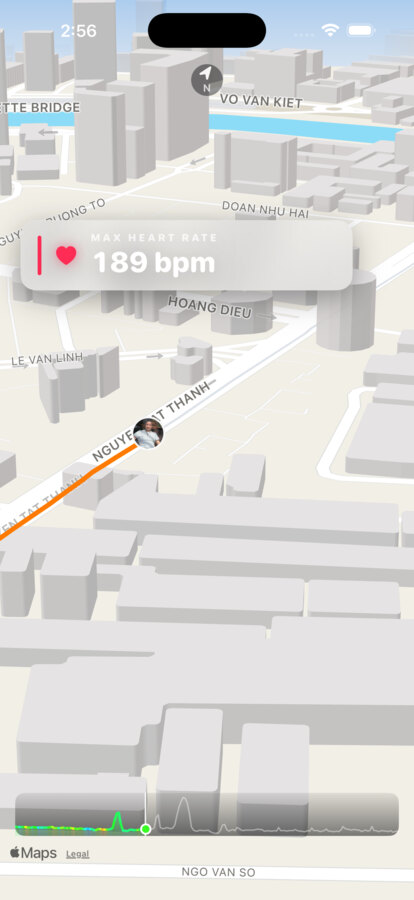
On the skyline shot, buildings stand up around your route as you pass through them. Ride through a city and the city is there — with the orange line threading between the towers and an elevation strip running along the foot of the frame.
The parts you are not supposed to notice
Most of the work here is invisible, which is rather the point.
Speed is matched to framing. Every angle plays back at its own rate — the tightest drone shot runs slowest, the widest reveal fastest — tuned so you cover roughly the same amount of screen per second whichever angle you are on. Without that, tight shots feel frantic and wide shots feel like nothing is happening.
Camera height is fought for. The map flattens itself when a camera drops too close to the ground, which would quietly ruin the steep skyline angle. That shot is deliberately held back to a height where the steep pitch survives and the buildings still rise properly into frame.
Cuts follow editing rules. It will not cut from Side Left straight to Side Right, because a mirror flip is disorienting. It will not cut between Front Lead and Rear Chase either, because it reads as though you teleported through yourself. These are the rules a human editor follows without having to think about them.
Vertical is framed differently. A 9:16 frame — the tall, phone-shaped one — is narrow, so at speed the lateral offsets pull in and the tightest shots drop out altogether, rather than letting you slide off the edge of the picture.
The camera eases. Heading and pitch settle rather than snap, with dead-zones to kill jitter and a catch-up when the camera falls behind you.
None of that is visible. All of it is the difference between footage and a film.
It opens by telling you what the ride was
Before the first camera move, the film introduces itself.
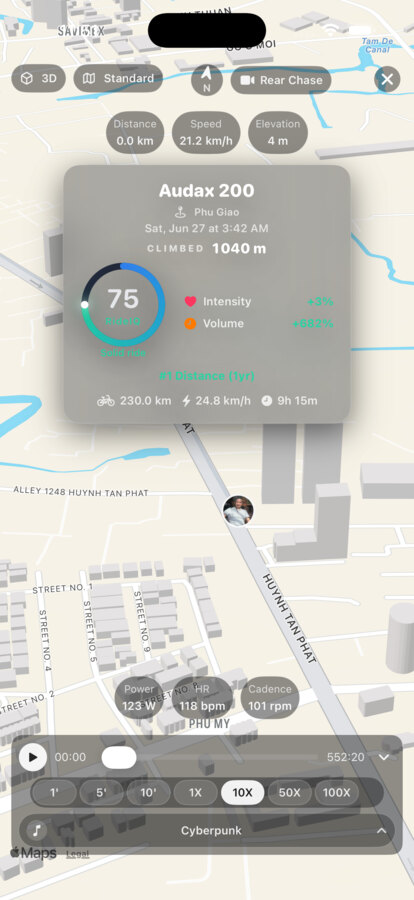
The opening card carries the ride’s name, the date and where it was — taken from the furthest point you reached rather than where you set off, so it names the place you actually went.
Then the headline effort: CLIMBED — 1,040 m. Total climbing, because on most rides it is the number that describes the day, and because it does not appear anywhere else on the card. On a genuinely flat ride it is left out rather than padded with a meaningless three metres.
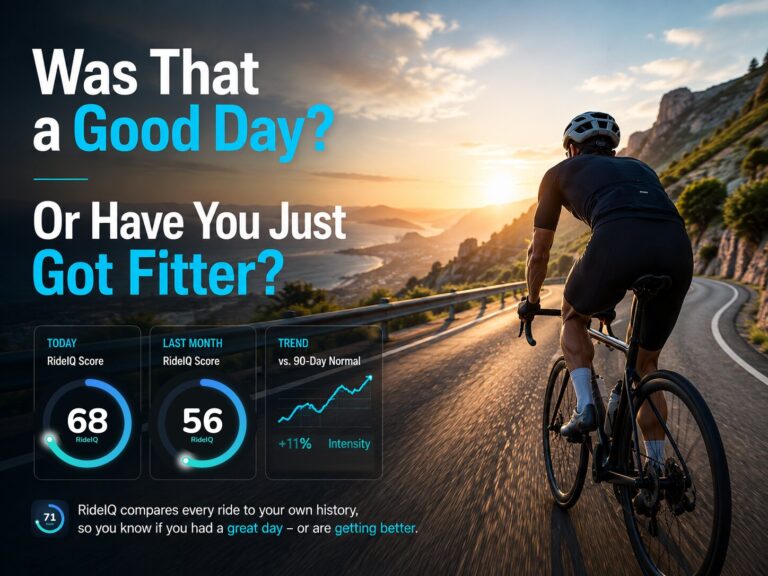
Your RideIQ Score sits in its ring. Beside it, two figures measured against your own norm — intensity and volume — and beneath, the ride in three numbers: distance, average speed, moving time. Across the middle, one achievement chip: the single most impressive true thing about the ride.
One detail worth pulling out. Those two deltas have a dead-band — anything within half a percent of your normal shows as neutral rather than green or red. A ride that came in 0.2% up is not an improvement, and dressing it as one would be a small lie told in a nice colour.
What the RideIQ Director does
This is the part that took the longest to build, and it is the part that decides whether the video is worth watching or just a dot moving around a map. Nothing here asks anything of you — the Director works the ride out on its own.
First it finds the peaks. It scans the ride for five maxima — power, elevation, speed, heart rate, cadence — and pins each one to the exact place and second it happened.
Then it ranks them for the screen, not the clock. Power and elevation lead, because they read best on video. A thirty-second export has only five clips to spend, so the strongest beats are the ones that survive.
Then it de-clusters. Your maximum power, maximum speed and maximum heart rate very often all landed inside the same forty-second sprint. Anchoring three separate clips there would produce a film about one hill. So peaks that close together collapse to one — and the ones crowded out are not thrown away, they are held back to caption other clips later. Every peak still gets its moment. It just does not get three.
Then it fills the gaps with a tour. If there are not enough distinct peaks to fill every clip, the remaining slots become evenly spaced waypoints across the route, so the film covers the whole ride rather than padding with repeats.
Then it captions everything, once. Clips are given their banners in a deliberate order of preference: the ride’s genuine achievements first, then the peaks that got crowded out, then any peaks left spare, then plain ride stats. No caption is ever used twice — if there are more clips than things worth saying, the spare clips run clean rather than repeating a banner.
And it always moves forward. The clips are laid out chronologically, so the film advances through the ride and the orange line grows steadily behind you. It never rewinds.
One last touch, and it is the sort of thing you only bother with if you care: a caption does not appear at the start of its clip. It waits until the shot is about a third through, so the camera has time to wind up to the moment before the number lands.
Every banner has to be earned
So you are not watching a dot move around a map. You are watching the ride’s actual story, captioned as it happens — MAX HEART RATE — 189 bpm arriving over the moment it occurred.
But a caption only means something if it is true, and this is where a highlight reel can quietly cheat.
A RideIQ highlight has to clear a real bar. A new high means the ride beat your own ceiling for sustained power or heart rate over a given window. A long ride or big climb means at least half again your typical moving time or elevation. A yearly placement means top three across your last 365 days — on distance, average speed, average power, average heart rate, climbing or top speed, or on a sustained twenty or sixty-minute effort.
The guardrails are the interesting part.
- Only twenty and sixty-minute windows count for effort placements. Short sprint windows are noisy and depend heavily on whichever road you happened to be on. A sustained twenty-minute placement means something; a ten-second one mostly means you found a downhill.
- A placement needs a real field. The ride has to beat at least three comparable previous rides before a top-three is awarded, so “top 3” is never quietly “top 3 out of 3”.
- The wording stays honest. “#2 Climbing (1yr)” says exactly what it is. It does not get promoted into “best climb ever”, because it is not.
The strongest genuine standout leads the intro card. The next few caption the clips. And if a ride simply was not remarkable, it does not get told that it was.
And it ends on the verdict
The film closes on a slow 3D orbit of the finished route — the full orange line drawn, you parked at the end of it — carrying the ride’s headline number: your RideIQ Score.
Then the end card.
It is a structural thing that matters more than it sounds. The video opens by telling you what the ride was and closes by telling you how it went, with the ride itself in between. That is a shape — and a shape is what makes something worth watching twice.
And then you can share it
Export vertical or landscape, thirty seconds or sixty. Vertical for the places people actually watch video on a phone; landscape when you want the wide reveals to breathe. Thirty seconds gives you five clips, sixty gives you seven, each on its own camera angle.
You can put music behind it too, from a bundled selection or something of your own, fading out as the ride draws to a close. That sounds cosmetic. Anyone who has ever put a ride video together knows the music does at least half the work.
What comes out is an ordinary video file that goes wherever you send it — friends, a club chat, family who have no real idea what you are doing out there for four hours on a Sunday morning.
This is also, quietly, how cycling recruits people. Nobody was ever talked onto a bike by a power file. They were shown a road.
When it earns its keep
Most rides do not need any of this. Tuesday’s loop is Tuesday’s loop.
But some rides are not that. Your first century. The climb you had been avoiding for two years. A week riding somewhere you had never been before. The last ride with someone before they moved away.
Those are the ones where a table of averages is a genuinely inadequate record of what happened — and where being able to sit and watch it back, months later, is worth something no metric was ever going to capture.
It will not make you faster
Worth being straight about where this sits.
Replay is not training. It will not build your week, prescribe an interval or tell you what to ride on Saturday — nothing in RideIQ does, and that is on purpose. Watching a film of Sunday’s ride will not make you quicker.
But it is not empty either. It opens on your RideIQ Score, with intensity and volume set against your own baseline, and it closes on that same score once the route is complete. The highlights it captions are real placements against your own year. The verdict on the ride is right there in the film.
What Replay does not do is work that verdict out. The analysis happens elsewhere in RideIQ — Replay carries it, wrapped around the ride it belongs to. That is a different job, and it is the one part of the app that exists because riding matters to people beyond what it does to their fitness.
That is deliberate. It is also why the banners had to be true — a highlight reel that flatters you is worth nothing the second you notice it is doing it.
The rides you will want back
Most rides fade by the following week. A few never do.
Years from now there will be a handful you still talk about. The morning the weather turned and you kept going anyway. The climb you had been promising yourself for two seasons. A road somewhere abroad that you did not expect and still cannot quite describe. You will remember exactly how those felt long after you have forgotten what you averaged.
A distance and a moving time were never going to hold that. They are a receipt, not a memory.
But the ride itself is not gone. Every turn of it, every rise in the road, the hour you finally felt strong — all of it is still there, waiting to be brought back. That is what the RideIQ Director is for: to take the day you had and return it to you as something you can watch, share with the people who were not there, and come back to whenever you want to feel it again.
Ride it once. Keep it for good.
Turn your next ride into a film worth keeping.
Free for 30 days, no obligation. Subscribe whenever you like — the rides you have already brought in stay yours either way.
New to RideIQ? See everything the app does →