Every club has a leaderboard, and most of them have the same problem: you can guess the top three before the week has started.
It is not that the ranking is wrong. It is that it is already settled. The strongest riders are the strongest riders, and a table built on raw output will keep saying so, week after week.
The problem is not the metrics. It is what you rank with them.
Distance, elevation, average speed, a segment time — all genuinely interesting numbers, and none of them a good way to order a group of people.
They are heavily decided by things nobody chose: power-to-weight — how much power you make for your body weight — years in the sport, how much time you have to ride, whether you sat in a bunch or went out alone into a headwind.
Put a first-season rider and a decade-deep racer on the same table and you do not get a competition. You get a readout.
So the same names sit at the top, everyone else stops looking, and the rider in fourteenth never finds out they just had the best week of their life.
A different question
RideIQ Club asks something else. Not who rode fastest — who rode best relative to themselves.
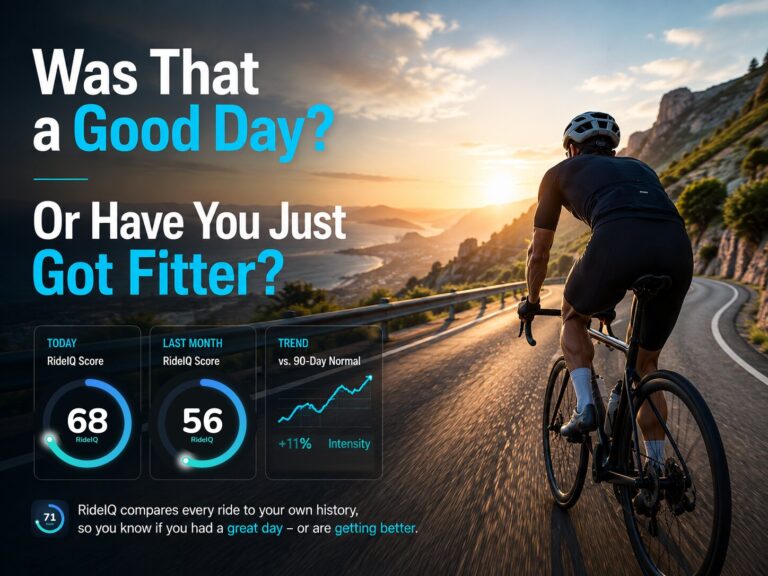
Every ride already earns a RideIQ Score from 0 to 100, measured against your own recent riding history rather than FTP tables or population averages.
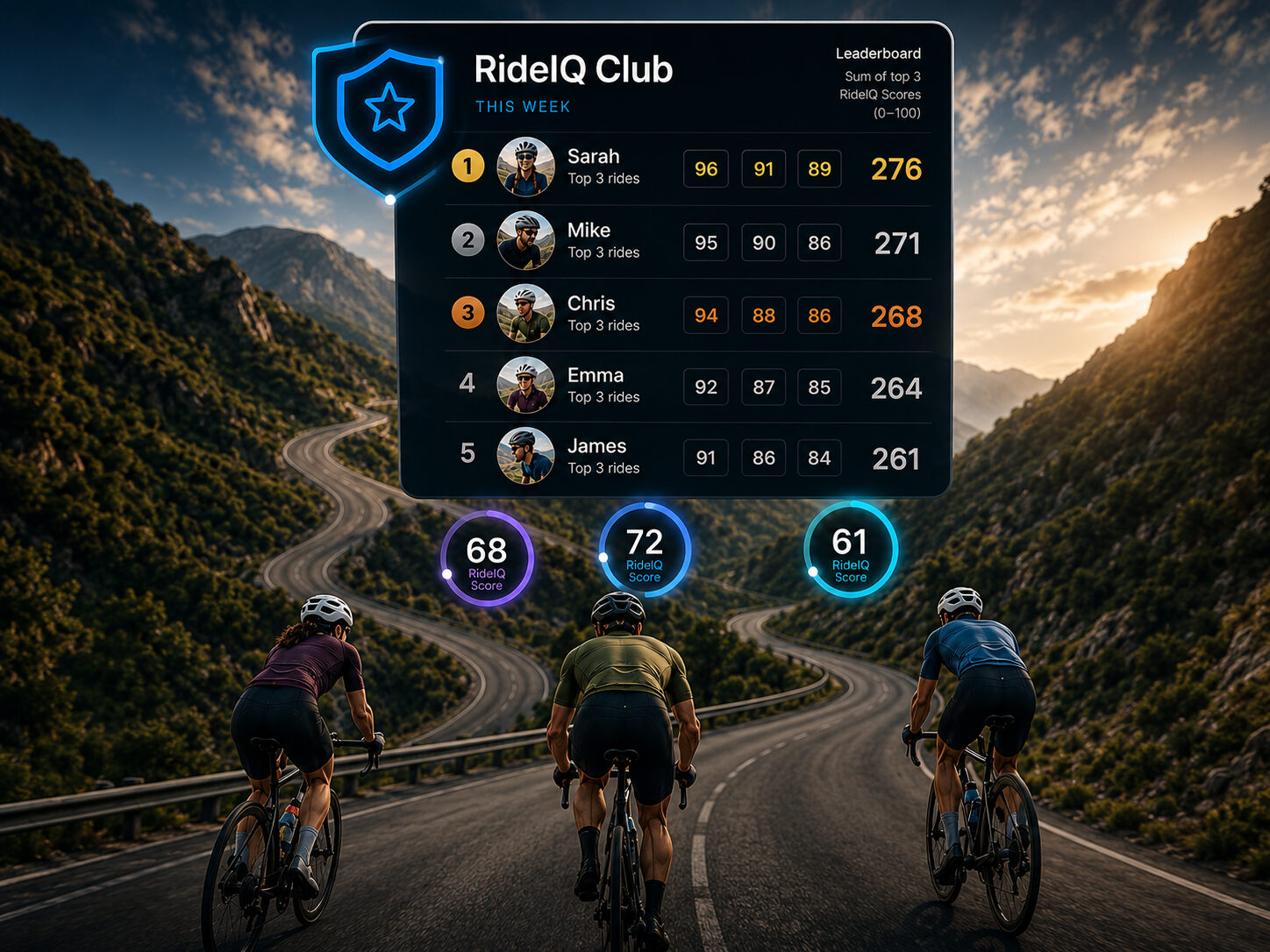
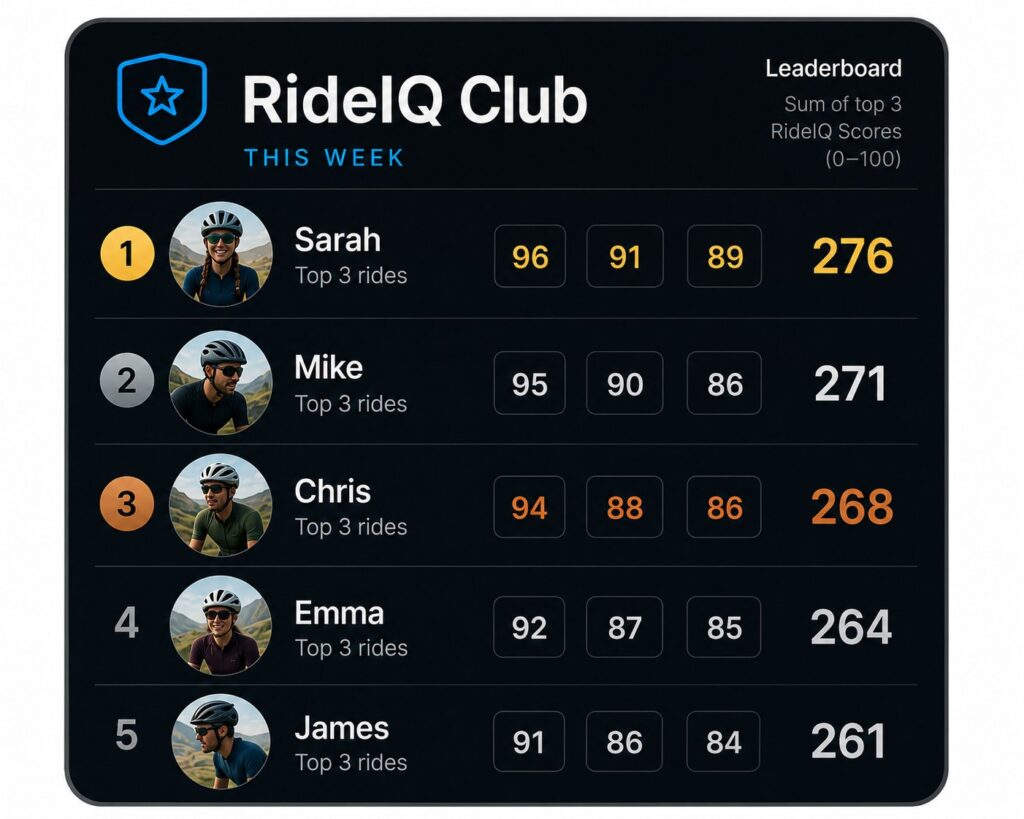
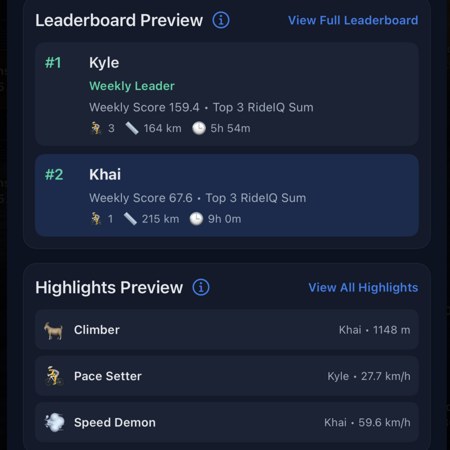
The Club adds up your three best scores from the week. That is the whole mechanic. Sum of top three, everyone on the same board.
Why everyone starts level
Because each score is already relative to the rider who earned it, a 96 means the same thing for everybody: that was an excellent ride, for you.
Sarah’s 276 and James’s 261 are not measuring who is quicker. They are measuring who put together the three best rides against their own normal.
A rider six months into cycling can top that board. So can someone fifteen years into racing. Neither carries an advantage over from last week, because nothing carries over from last week.
Three rides is the whole design
The number three is doing more work than it looks.
- It caps the top. Riding every day does not compound. A seventh ride adds nothing a fourth did not, so nobody wins the week simply by having more free time than everyone else.
- It lowers the bar to entry. Three is a realistic week for someone with a job, a family, and a Tuesday that fell apart. Miss four days and you are still fully in it.
- It removes the cost of easy days. If your week were averaged, every recovery ride would pull you down and you would be quietly punished for riding sensibly. Only your best three count, so an easy spin — or a genuinely rubbish day — is not a penalty. It simply does not count.
That last one changes how the whole thing feels. Nothing you do in a given week can hurt your position, so you are free to ride easy when you need to and hard when you want to. The table only ever reflects your best.
Three great rides beat one all-out hero effort — and they beat seven tired ones.
The rest of it still counts
None of this means distance and speed stop mattering. Open the Highlights tab and the same week is measured every conventional way there is — Climber, Pace Setter, Speed Demon, Diesel Engine, Sprinter, Volume Beast and Addict. Most climbing, highest average speed, top speed, highest average power, maximum power, most kilometres, most rides.
They just are not the ranking. Nobody wins the week by topping the speed trap.
This matters most for the strongest riders in the club. A leaderboard built on relative performance could easily feel like it takes something away from them — all that ability, and nowhere dependable to show it. Highlights are where it shows. The fastest rider in the group will still own Speed Demon and Sprinter most weeks, and they should.
The strongest rider does not always win. They also do not get left out.
Monday to Sunday, then it clears
The week runs Monday to Sunday, and it tends to build. Most riders save their biggest ride for the weekend, so the board is rarely settled before Sunday evening.
Then it clears.
No season-long points total. No accumulated lead. No gap that has become mathematically hopeless by March. A bad week costs you that week, and a good week counts in full regardless of what came before it.
Which makes the answer to is it worth riding this week? always yes.
What this is not
Worth being clear about what the Club does not do.
It does not tell you who the strongest rider in the group is. If that is what you want, race one, or go and compare a segment time. Those answer the question honestly, and the Club does not try to.
It does not prescribe anything either. It will not build your week or tell you what to ride on Saturday — we made that case in Your Zone 2 isn’t always Zone 2, and the reasoning behind scoring every ride against your own history is in Stop chasing estimates. Start measuring progress.
What it does is take the riding you were already doing and make it count for something, among people you actually ride with, on terms that do not quietly rule most of them out before they start.
Everyone races the same leaderboard
Everyone has a different finish line. That is the point.
The strongest rider does not always win. The most improved does — and in any given week, that could be any of you.
Give everyone you ride with a leaderboard they can actually win.
Free for 30 days, no obligation. Subscribe whenever you like — the rides you have already brought in stay yours either way.
New to RideIQ? See everything the app does →